PIERRE MAGENDIE AND NICOLAS VAMVOUKLIS, A DIALOLOGUE
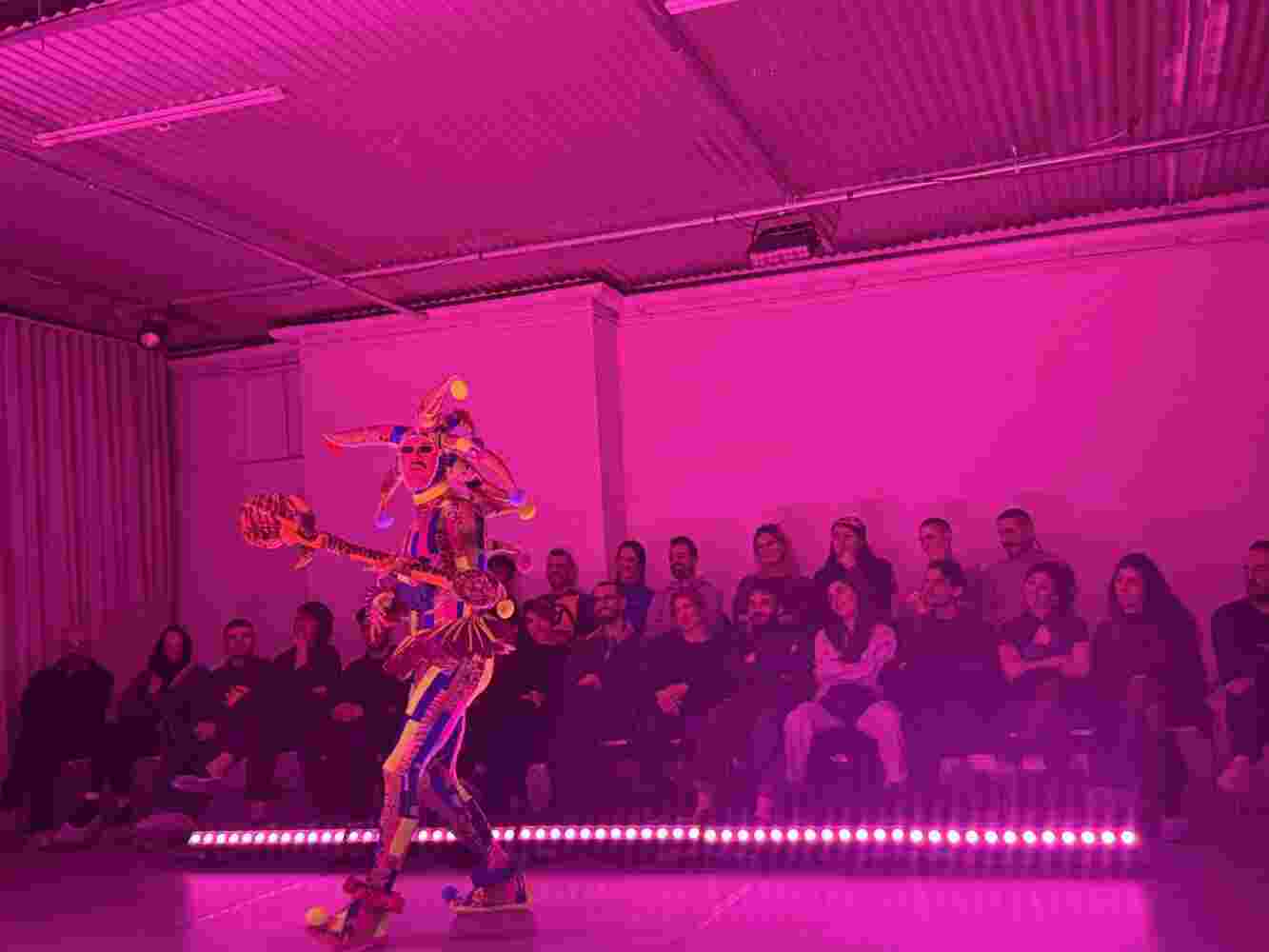
On Sunday, February 15, 2026, after the performance DA LULU at M54 in Athens, Pierre Magendie spoke with curator Nicolas Vamvouklis about how his new work was conceived and staged: from the earliest try-outs and practical decisions to the relationship between choreography, performance, image, and sound. Starting from the Greek word “lolò” (approximately “fool”), they explore what it means today to drift outside the norm, when the absurd can start to feel like the rule, and how this shift translates into a live stage presence.
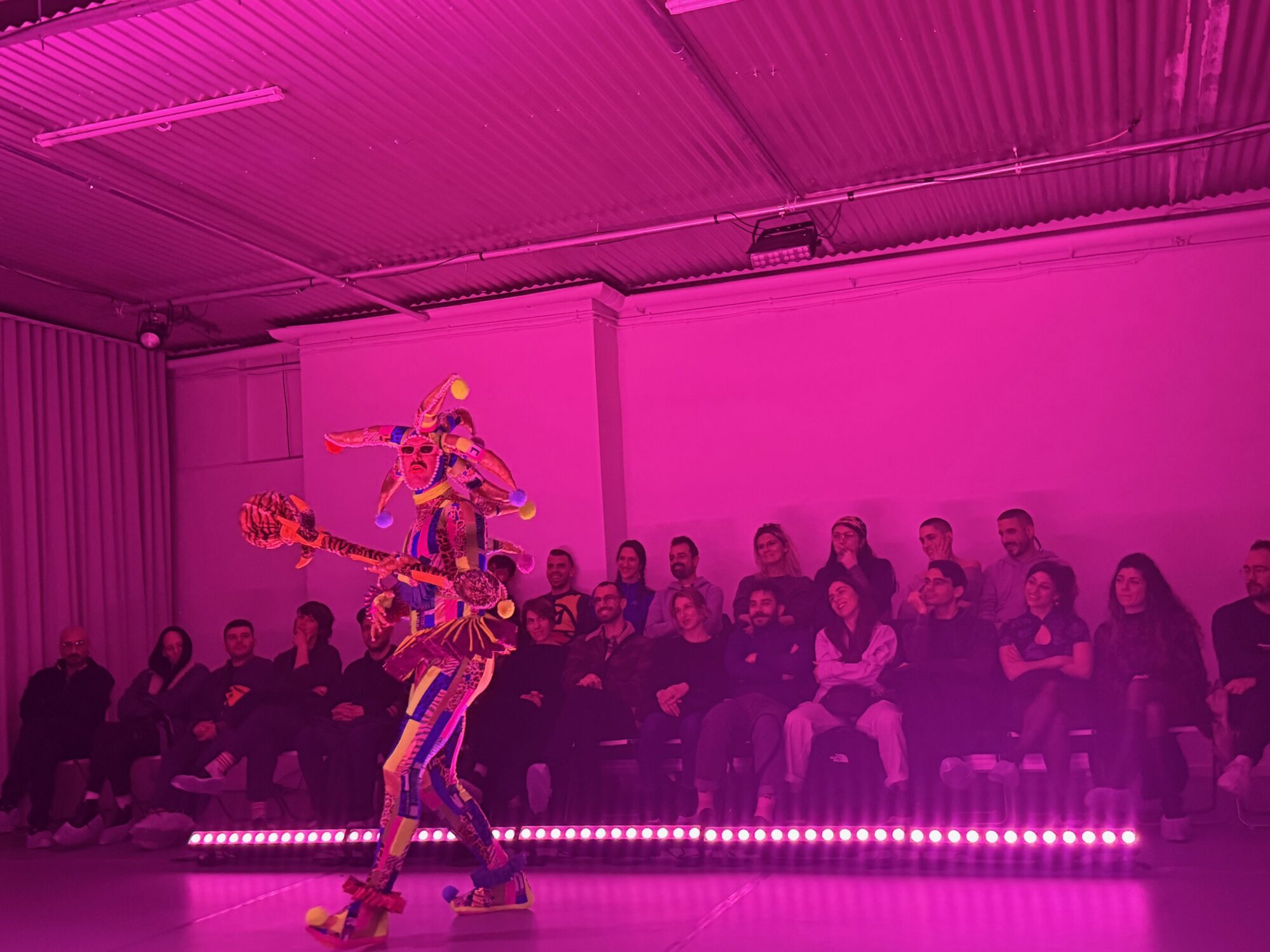
Nicolas Vamvouklis (NV): Kooky, crazy, bananas, DA LULU! What does the title of this new work mean to you? And, in the end, what is “lolò” today?
Pierre Magendie (PM): Before I got into dance, I studied literature. So wordplay and this obsession with language have seeped into the work. At first, I wanted a catchy title, because we want to go on a world tour (laughs). As we tried to define ‘lolò,’ both during preparation and now that the piece is on, we made a conscious effort not to pin it down. “Lolò” is great in Greek because it’s neutral gender. Is it a creature? A concept of pure silliness? Is it the non-binary citizen of Athens in 2026? It’s probably all of it. It can hold many things at once. We wanted to keep the field open. The words you mentioned are only slightly different, yet they describe something similar. “DA LULU” (English title loosely translated from the Greek one “TO LOLO” for its proximity with both “looney” and “delulu”) was the funniest to the ear because of its repetition; and almost half the piece is built on it. “Crazy” brings up the straighjacket. “Bananas” goes somewhere else. So we kept it broader.
NV: How was this piece born? What was the first spark?
PM: Fire everywhere this year, because we’re heading into the Year of the Fire Horse in the Chinese zodiac (laughs). The work began in 2019 and it was kind of prophetic. I started rehearsals in December, right before the pandemic. I wanted a new production and fate told me: no. Calm down. So the title fit perfectly. I had that artist’s itch to make something new, to prove I have value. “VaLULUe”. I said: I’ll do it alone. I rented a space, rehearsed for two months, and got depressed because nothing was coming out. I was miserable. Everything looked like trash to me. And then Covid-19 hit, so it didn’t move forward. Then life happened: jobs, love affairs, all that. Now, thanks to ARTWORKS’ support, I was given a chance to realize my ideas, gather people, and work in more professional conditions.
NV: How did it develop in practice? This idea of the absurd—today it feels like it’s becoming almost the norm—how did that translate into a performance?
PM: There are two sides. One, and maybe the most important, is personal: feeling “lolò” in situations where you don’t belong. The other is more collective. Over the last five years, it feels like everything has gone “lolò”, or is moving toward a kind of “lolo-ification.” So how does the absurd, inside me and around me, become a work? That’s the magic of the performing arts. You have an idea when you’re alone, but you despair quickly. Then comes the back-and-forth with amazing collaborators like Maria Vourou, Sakis Birbilis, Elena Novakovits, Anna-Maria Rammou, and Photoharrie. Little by little, your scattered thoughts take shape and you change your mind. You realize, okay, it’s not shit, because this process finally leads to the masterpiece you saw (laughs). It’s a collective journey. There’s no other way.
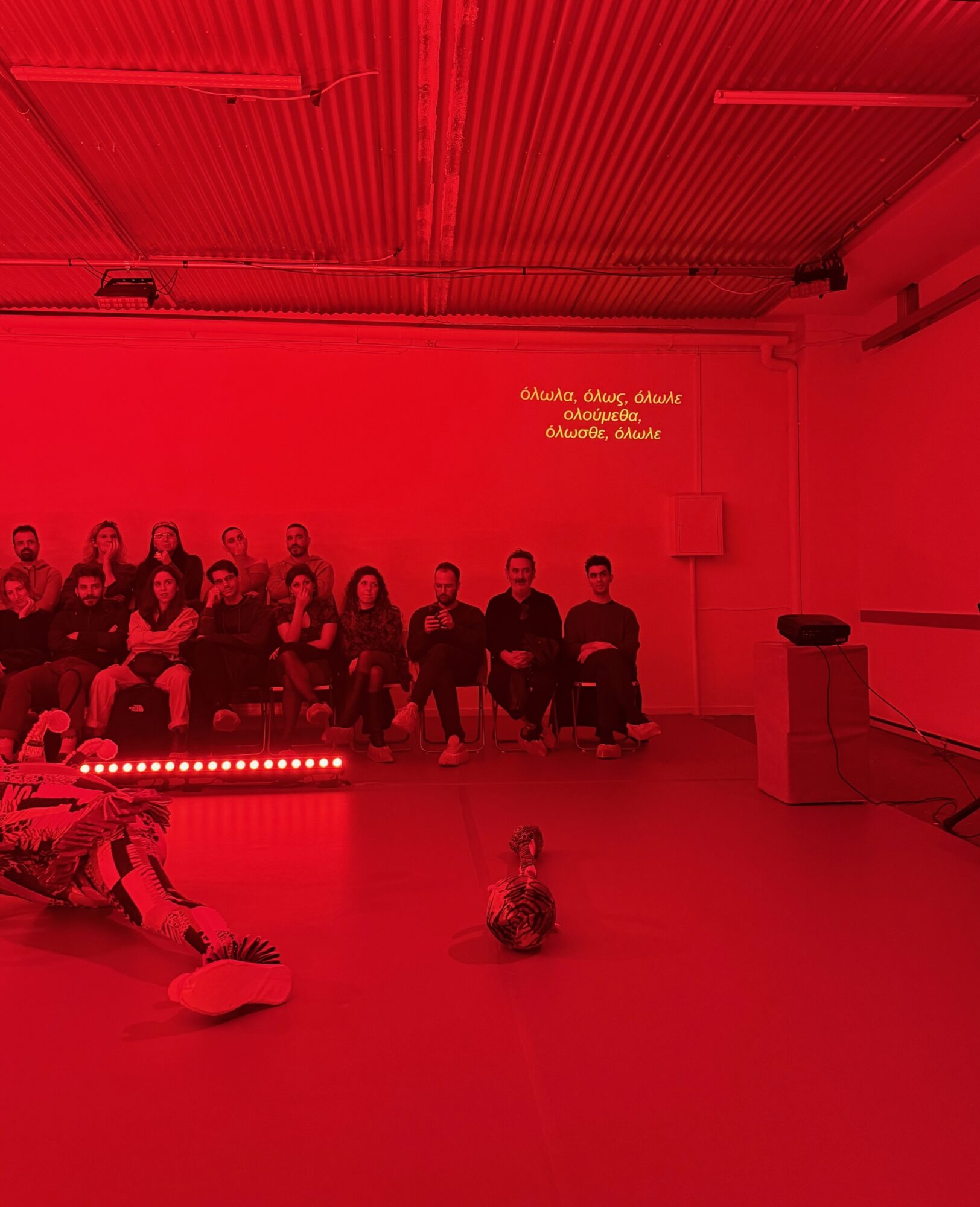
NV: Text is very present in the work. How does writing enter your practice? I’m interested in how you handle language, especially your choice of Greek and its relationship to gender. How do you decide what to say, and how to say it?
PM: I’m 40 now. I’ve spent half my life here. Greek isn’t my mother tongue, but in a way my “mother” tongue isn’t really my language anymore. My French is also kind of… 90s, so when I go to France I feel a bit boomer. My everyday life is here. Writing came instinctively, partly because I studied it, and partly because, as a person, I like making jokes, playing spontaneously with the material around me. Even though I avoid definitions, I define myself first as a dancer. Dance has something non-logical about it; it doesn’t rely on speech. The body goes first. I like how speech and movement can coexist without one explaining the other. They run on the same frequency. Rehearsals start from ideas. For example, I wanted to work with Pontian dance. I tried movement material that then influenced the sound too. A kotsari turned into techno and landed at the very end. That’s also how language works for me. How funny can a word like “lolò” become? The challenge is to illuminate what’s going on around us, without letting the smile drop.
NV: At some point, across your various announcements, you say: “Enjoy responsibly, enjoy freely and… under siege.” What does freedom mean to you? Do you feel free?
PM: “The Free Besieged” [epic poem by Dionysios Solomos about the Greek War of Independence]… I think we French can’t resist a bad pun. I enjoy that urge to compare ourselves to monuments. Obviously it’s done with humor. There are other things like that too in the work, like “I’ve got potaaaaatoes” or “the person who is serious, is serious.” References, some historical, some everyday. I’m not sure about freedom; I’m not a philosopher. But I do like mixing the grandiose with the banal. The sublime and the “lolò”.
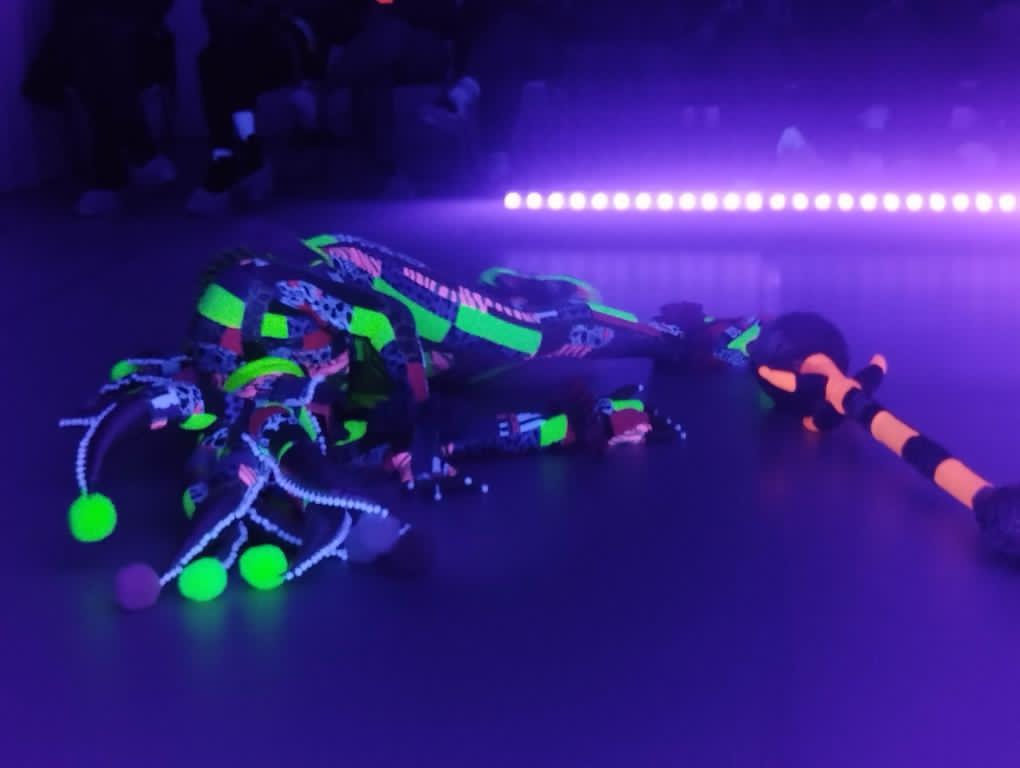
NV: Another line that stuck with me: “If you allow something to happen, does that mean you’re encouraging it too?” Want to try and answer that?
PM: A lot of the time, we’re allowed, and even encouraged, to do many things. And yet we limit ourselves. I wanted to make a piece where I put everything in: splits, turns, somersaults—everything I’ve done over the years, all the elements of my path so far. To do it on stage with no restrictions for me, and no restrictions for how the work is read. That’s also how I want to live. And I do. Mic drop (laughs).
NV: Your characters often have an extravaganza element. What does this aesthetic of abundance mean to you?
PM: I’m interested in the work reaching beyond Greek, so we translated the title TO LOLO into English as “DA LULU.” There’s a part of me that’s exactly that—delulu. Deep down I believe I’m not excessive. I’m measured. It’s just that my “measured” probably doesn’t match reality. But which reality? It matters that I grew up in the provinces. When I say I’m French, everyone thinks Paris. I have nothing to do with the capital. I grew up in a small town on the far edge of the country, like being outside Xanthi (laughs). My environment was lacking variety. As I say at the beginning of the performance: “Nice to have so much choice. Elsewhere, there’s isn’t much.” I grew up with a lack of stimuli and a restricted horizon. Coming to Athens, I discovered the city’s excess and chaos, and it enchanted me. That’s why it became my place. People ask me: what is a French guy doing in this dump? It’s about how a place answers what you’re missing, how it fills in the gaps.
NV: Your first costume feels like a collage. What are all these elements you’re bringing together, and how do you choose them?
PM: Sewing entered my life by accident. I was studying at the National School of Dance and wanted to make costumes for a piece, but had no idea how. I went to Kalamiotou Street, bought fabric, needles, and thread. I made my first skirt and I was over the moon. Then I got a sewing machine. I dressed the house, the furniture, myself. And fifteen years later, here’s the spectacle you saw today (laughs). The costume is lycra, like cyclists wear. It becomes one with the skin and it flatters you. Some pieces I’d bought earlier and never used. Some are new. I don’t know if there’s a specific meaning. I just know they were beautiful and they fit in my head. In rehearsals we tried a black light that took it to another level, and of course we kept it. The magic of the performing arts strikes again! The important thing is that, like most things I make, it’s patchwork. Upcycling is trendy, but that’s also how my brain works. I throw things in the blender, see what comes out, and then I tidy it up. Like our conversation, which someone is probably reading right now…
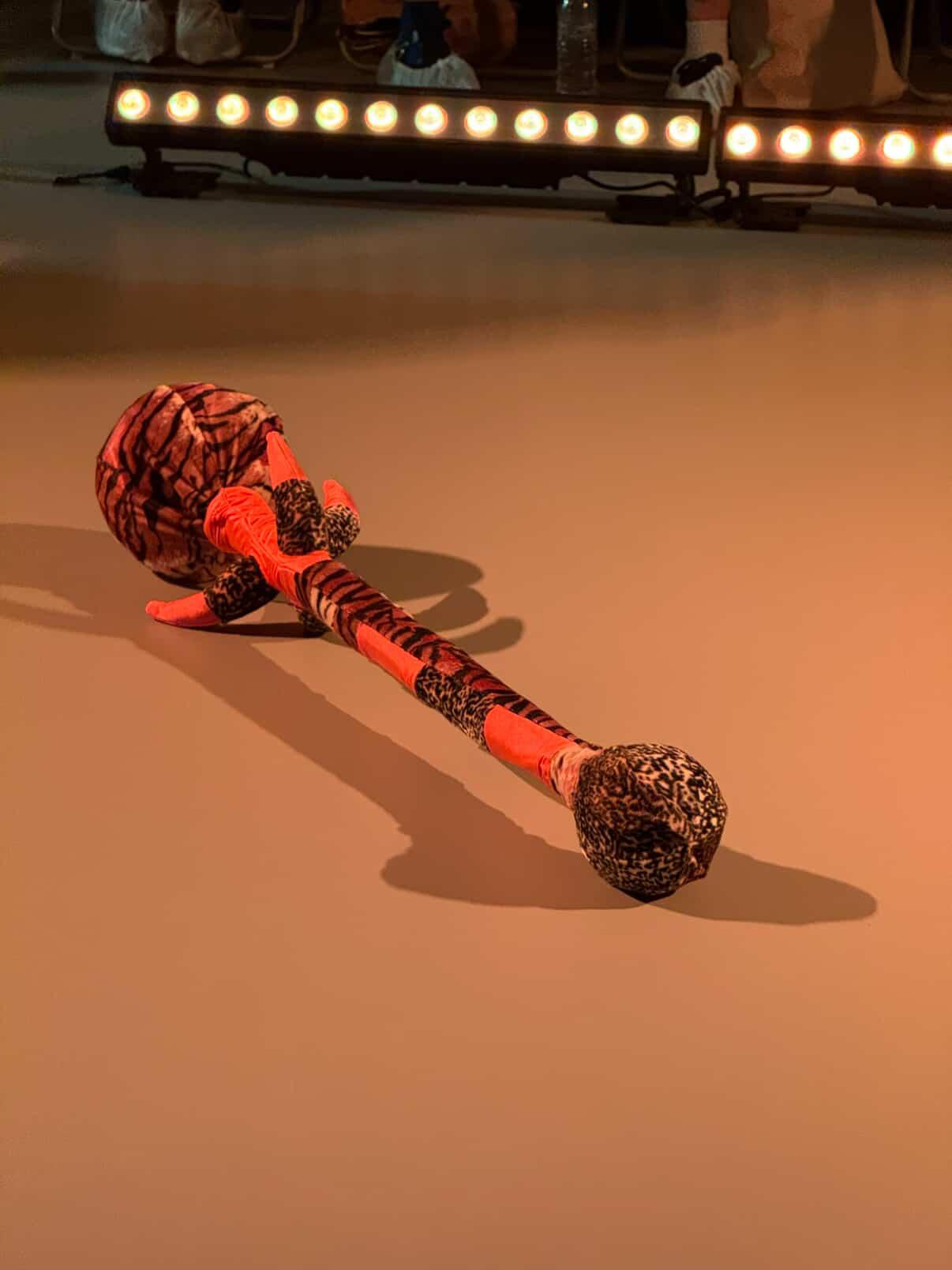
NV: Let’s talk about the set. The layout feels like a catwalk. Why did you choose it? What does it do to the relationship between performer and audience?
PM: I’ll tell you a story. I did a job abroad and, when it ended, the dancers gave me a t-shirt that said “WHY?” on the front and “WHY NOT?” on the back. I hadn’t realized how often I say it! A lot of things don’t have an explanation. They just happen. I chose the runway because, first of all, I’m a fashion icon (laughs). Seriously though: I don’t like the frontal logic of theatre: someone up on stage and the audience below. Here, the “lolò” is me, it’s you, it’s all of us. You look at me, but you also look at the person opposite you. Yes, the runway has its own architectural logic, but the main idea is visibility. The performance is an excuse to all be together and enjoy the moment. Cheers, everyone!
NV: I loved the kimono you wear at the end. You had a similar one in 2018, in a performance we organised on Lesvos. I remember the next day a kid asked: “Will the guy who kicks his foot into his head come again today?” He was that impressed. It seems like it’s your signature move. In recent years, there have been steps to promote dance across Greece. You also said earlier: “We’re stuffed with art, art, art, art.” What’s missing, and what would you like to change?
PM: That kick, the battement, connects to the “what are we allowed to do” and “what are we encouraged to do” we were talking about. Dancers train systematically in ballet and contemporary, and at the peak of class you’re meant to throw your leg as high as possible. You do it every day, for three years. And then you go to a show and you never see that step, not once! But why? (laughs) As for art in Greece… I’m not sure what exactly I’m doing. Is it dance? Theatre? Performance? Inside, I believe I’m presenting dance. When I hit my foot to my head, people immediately say: “dancer.” I’ve worked a lot abroad, for example in Germany, where dance is supported by the state. Even in the smallest city there’s a state theatre with a 20-person company that stages at least one Carmen and one Swan Lake every year. The small city produces its own art. Here, there’s nothing like that. Support is missing, and education is missing too. In 2006, when I came to Greece, I saw the Ai-Gianní bonfires, people at the panigyria, drums, lyres, chaos. It’s not that dance doesn’t exist. A lot is certainly happening. But who is the audience? More than half the people who came tonight are my friends. Maybe we also need to think about what kind of dance the public wants. The “high-art” kind, or the popular kind? It’s no accident that this is how the performance ends.
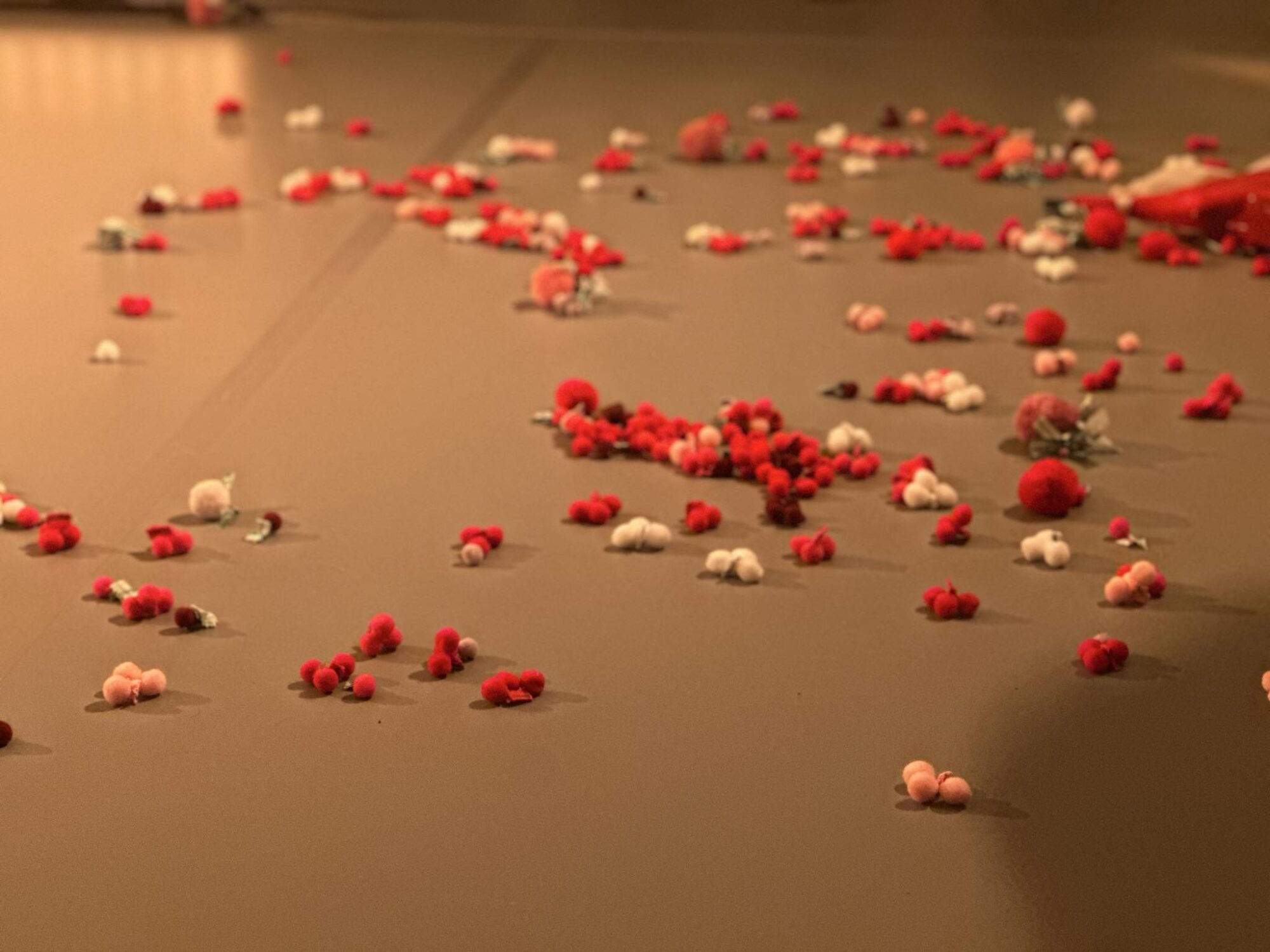
NV: You close with a paraphrase from Paschalis Terzis’ zeibekiko: “Long live the madman and his madness, the one he carries in his mind. In the world’s insanity, he found himself.” It sounds like a blessing and a curse at once. Let’s close with your own wish, for you, for the world.
PM: Long live DA LULU, you and your dreamy delusion.… That’s what I am, that’s what I’m selling. Does the world need it? Maybe. I’m not a politician. Is dance a political act? Obviously. Just like the coral leggings I’m wearing. My message for the future is this performance—like a strange, off-kilter feast. An invitation to connect, have fun, and enjoy togetherness. Hang in there.
__________________________________________________________________________
DA LULU by Pierre Magendie
Performances: 14, 15, 21, 22 & 28 February and 1 March 2026, at 20:00.
M54, Menandrou 54, 10431 Athens.
Learn more about DA LULU and Pierre Magendie here: https://art-works.gr/en/project/da-lulu-to-lolo/
DA LULU is supported by the 2025 ARTWORKS Grants program funded by the Stavros Niarchos Foundation (SNF) and other individuals.
Nicolas Vamvouklis is a curator and writer. He has been awarded the Stavros Niarchos Foundation Artist Fellowship by ARTWORKS (2021).
The photographs are a kind courtesy of audience members.