THE CITY OF MARBLE STEPS
Before arriving in a city we have never visited, we already carry fragmentary, imprecise, and somewhat impersonal images that reach us from different places. This is especially true when the city in question is Athens. The wealth of images, histories, and references stretches back more than two and a half thousand years, and the ways in which these images have been transformed, simplified, and commercialised are enormously varied.
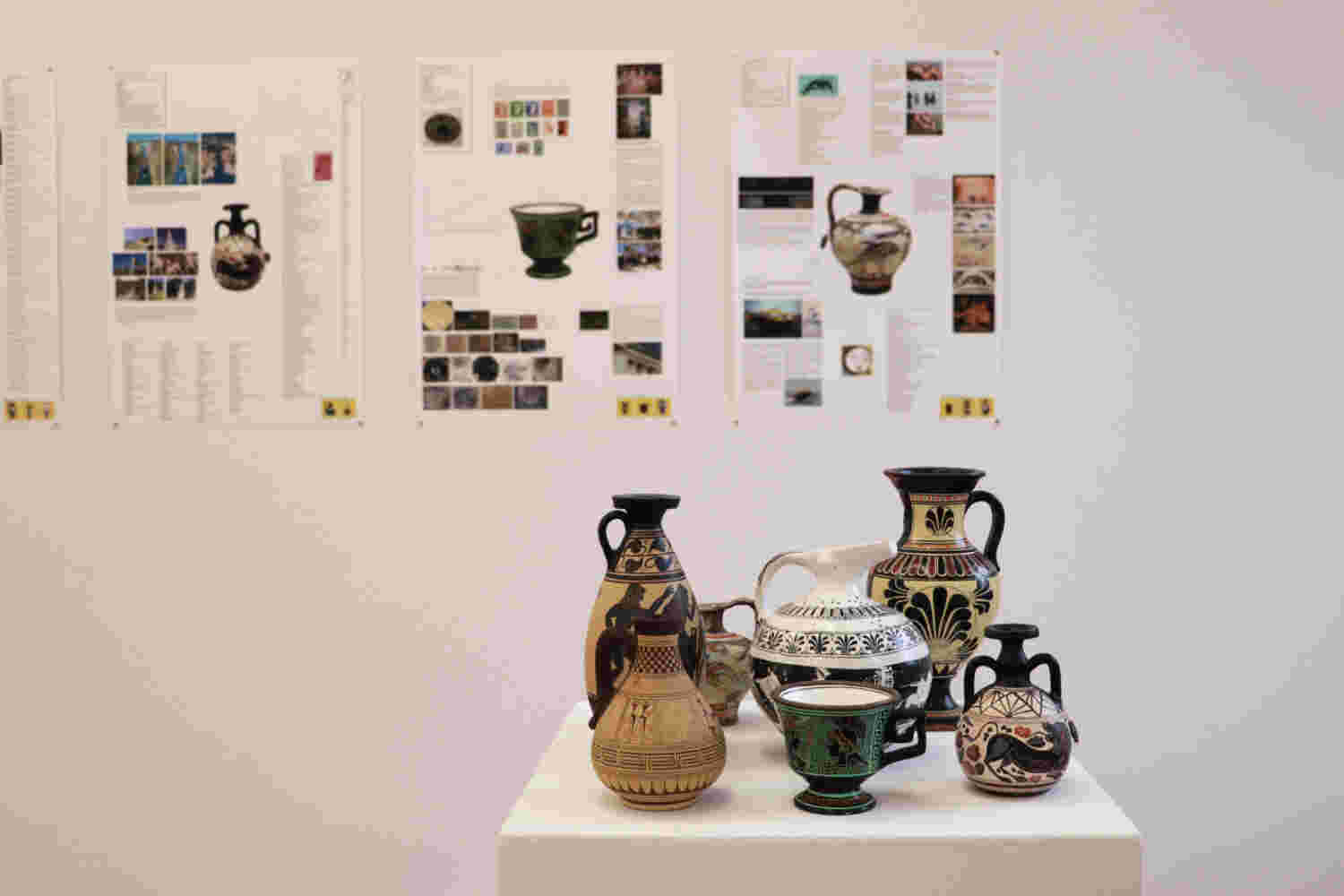
A project by The Phantom Investigations, an artist collective composed of Giannis Delagrammatikas and Ino Varvariti, made me think about those images of Athens and of “Greekness” that I carried with me before my journey. The project, titled The Willingness to Revisit (2012–2018), is an investigation in which, during their residency in Berlin, they visited various second-hand markets and encountered a very particular typology of Greek “souvenirs”. Ceramic copies of archaeological vessels, replicas of classical sculptures, postcards of seascapes, and travel photo albums featuring the main archaeological remains are among the findings that shaped, for them, a particular way of thinking about collecting and what carries the memory of a place.
Within this project, they produced a presentation titled Open Containers – The Long History of the Form of the Vase (2018), a series of illustrated sheets with images and texts that analyse these ceramic vessel souvenirs as objects functioning as a memory of tourism and, therefore, as bearers of narratives shaped by ideological, institutional, historical, and political frameworks. It is a way of problematising the image of a locality within a global discourse, considering the significant role these objects have played in promoting and developing tourism and in constructing “Greekness”.
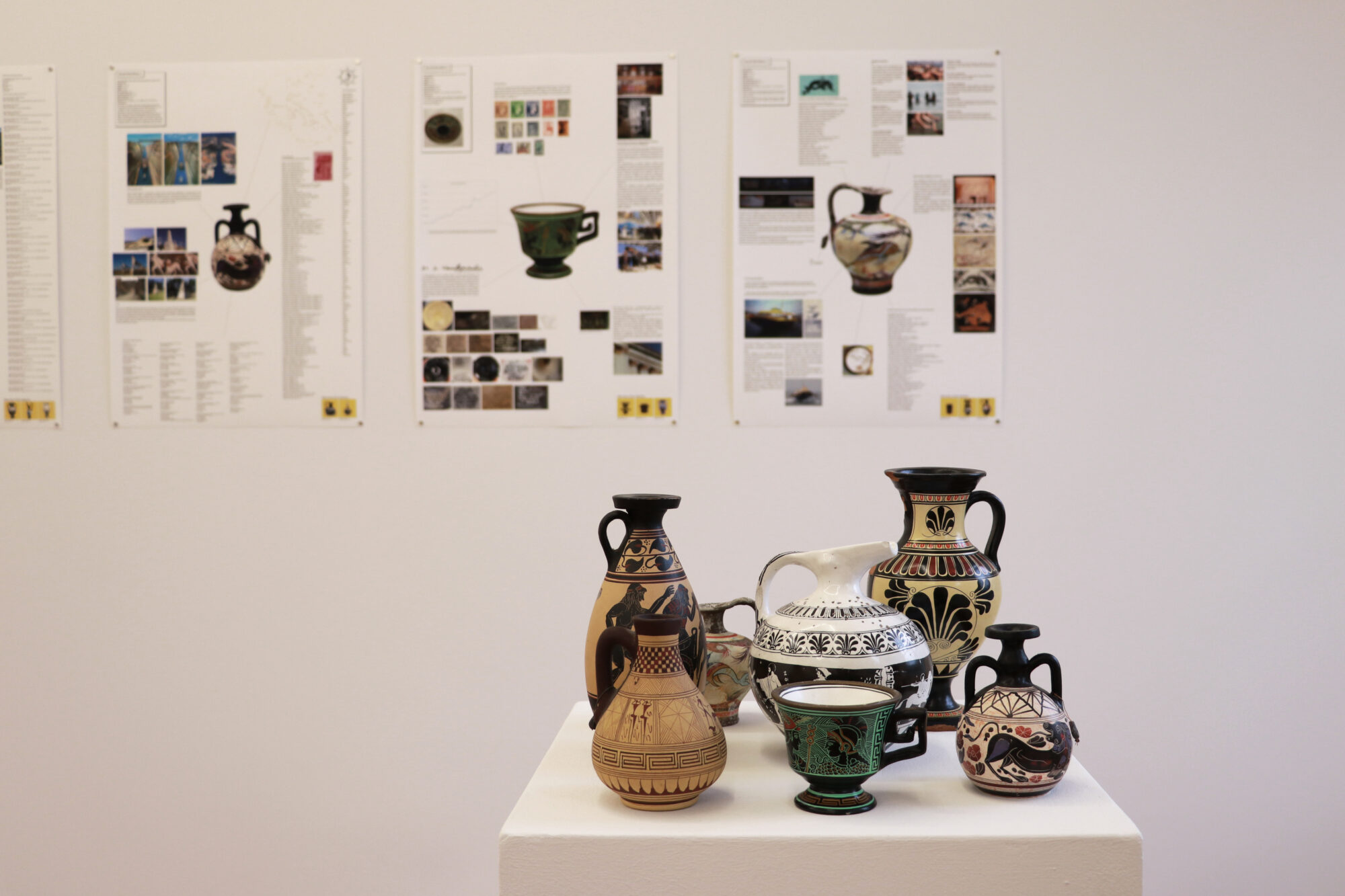
The Phantom Investigations (Giannis Delagrammatikas and Ino Varvariti), Open Containers, The Long History of the Form of the Vase (2018)
For them, these travelling objects —souvenirs and witnesses to the expansion of tourism— are domesticated, stereotyped, and hegemonic images that refer exclusively, on the one hand, to ancient Greece and, on the other, to the qualities of its sea as an exemplary paradise. They are a type of export product oriented towards generating desire and status. The research charts produced by The Phantom Investigations bear some resemblance to the images I held of Greece in general, and Athens in particular, before setting out on my journey.
My relationship with Athens had been centred on that polis which seems to resist time and which, though in ruins, still stands. My interest in the art and philosophy of a past more than two thousand years old was directly proportional to my ignorance of the contemporary city, a significant distance from the present. Although encountering the remains and vestiges of Antiquity already implied considerable excitement for me —and represents one of the principal dimensions with which the city coexists— the real adventure was engaging with contemporary Athens.
To that historical image was added another, more imprecise but equally resonant one: more specific, almost a detail. Before travelling to Athens, an artist told me enthusiastically: “at the Acropolis, even the steps are made of marble”. I was not entirely surprised, since it is well known that marble is the architectural material par excellence of ancient Greece, but the observation kept resonating as an invitation to look carefully. In some ways, this image began to structure a specific point of view on Athens, though it also converged with aspects already present in my current research, which shaped the initial impulse of the journey.
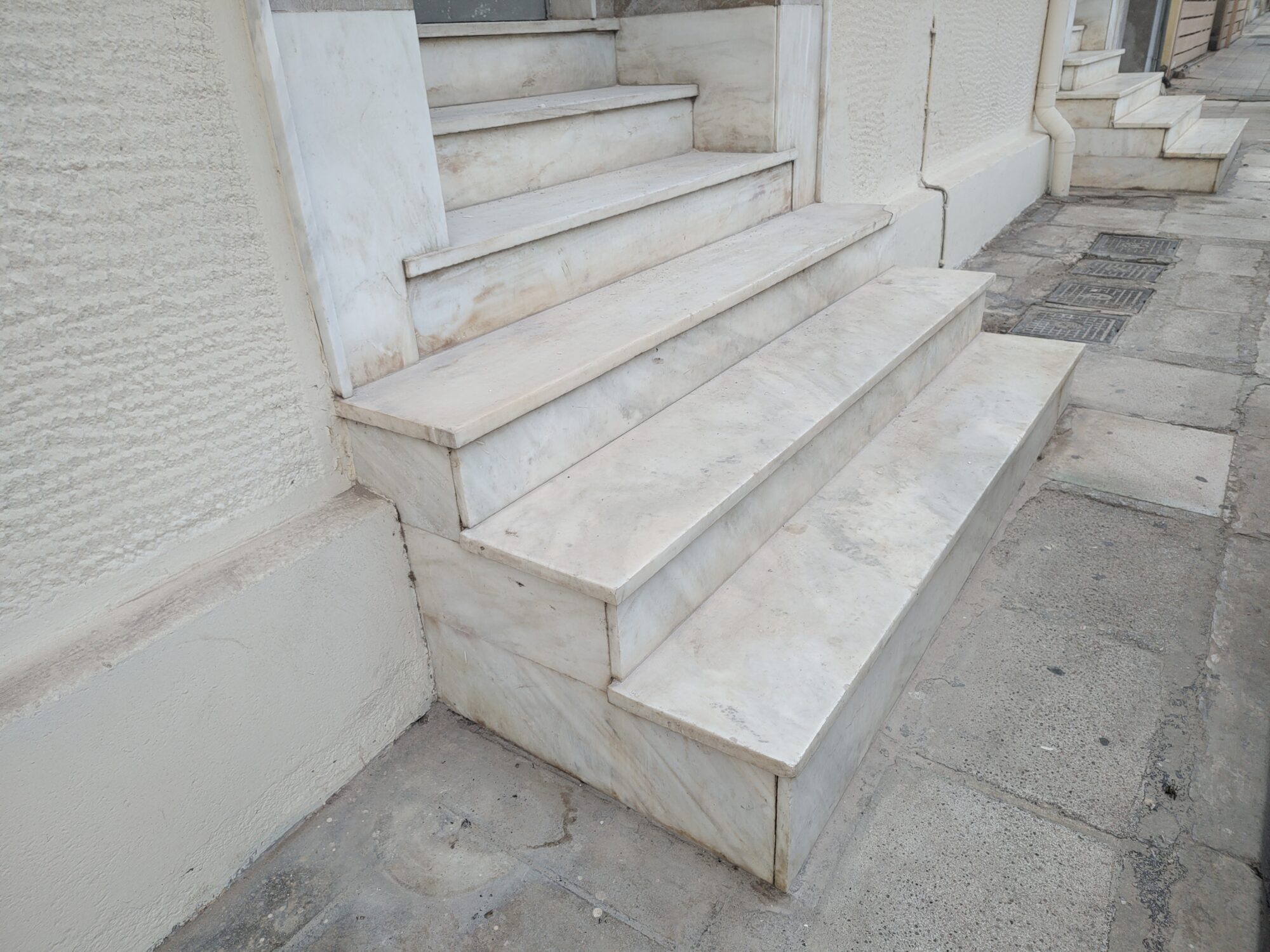
Clarisa Appendino, Athens, 2025
This research is articulated around two tensions that, in artistic practice, become inseparable: a material dimension —what things are gathered, what temporality they contain, what obsolescence defines them— and a gestural and procedural dimension —the materials used and the manner of finding them, the regime of the gaze implicit in the encounter. In the works of the artists I visited, both dimensions appear intertwined.
The material dimension departs from the notion of Fragmenting Obsolescence: a perspective that recognises the multiple signs of a renewed failure of the idea of progress. A progress structured along a straight, upward line that has governed developments across all spheres. One of these is the notion of obsolescence into which things, materials, and beings fall after having “served” some kind of utility. Although this concept originates in the technological and industrial artefacts that, from the 1980s onwards, programmed the durability of devices, it is linked both to replacement through new technical advances and to the stimulation of consumption and fashion.
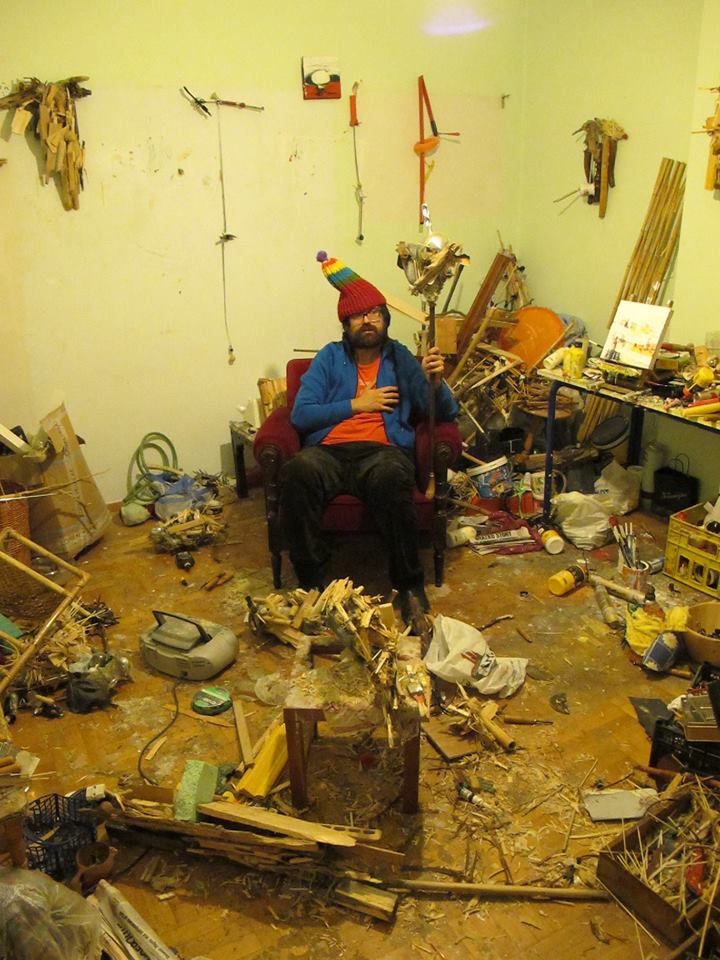
Αmeladiotis Dimitris, Atelier’s conditionality, 2017, a solo show curated by Apostolis Artinos at the studio-home of the artist
Fragmenting Obsolescence had its first curatorial realisation within the framework of BIENALSUR 2025, exploring works and artists that propose possible fragmentations, ruptures, and shards to the modern —and contemporary— notion of technological progress. A progress that has led us to an unprecedented crisis, making it crucial not only to imagine alternatives to that linear temporality we have adopted for things, materials, and beings, but also to analyse the forms in which obsolescence is structured in the present.
In most cases, the cultures and societies of the past —and, therefore, also of the present— are known primarily through what they discard. This approach, when applied to the analysis of certain artistic practices, proposes an observation of the relationship between matter and time, the durability of things, and the devices of the future built from technologies of the past. These ideas resonate throughout the work of several artists I visited. With a great diversity of materials, procedures, and ideas, many converge in a particular way of approaching the relationship between time and matter.
In the work of Odysseas Glykas, time reaches back to remote situations and emotions, almost attempting to attain a certain bareness of the human condition through pictorial scenes and the production of objects from gathered materials. His works reveal an intersection of organic materials —most of them collected on the outskirts of Athens—: tree leaves, bark and trunks, bones and hair, feathers and hides. All elements that approach death, which lends the conjunction a mixture of temporalities and an atavistic force. Although his work implies, as gesture, the act of gleaning and a revisiting of the dying state of certain things, its power more closely resembles that of a hunter than a gleaner. Hence the atavistic and sombre force that appears in many of his images and objects.
In keeping with this kind of attention to the perishable and obsolete condition of materials, Vasili Galanis and Fiona Elli Spathopoulou work, both individually and collaboratively, on technological ruins, overlaying archaic procedures onto technological materials. The world of disused screens becomes a support for drawings inscribed directly onto the surface. That black mirror ceases to be a mirror for reflection or an emitter of luminous images, becoming instead an opaque surface, almost without depth, on which to scratch, engrave, wound, and mark those smooth, traceless surfaces. It is an archaic procedure —leaving a mark by pressing onto a hard surface— executed on a technical surface. Such a procedure appears in their individual practices: Fiona Elli Spathopoulou uses monotype on copper and stone with motifs drawn from memes or TikTok influencers, whilst Vasili Galanis creates scenes from moments of the classical past, still in ruin, rendered as oil-painted video game scenarios.
In other artists, this tendency shifts towards certain practices involving landscape. This is especially evident in the work of Alkistis Mavrokefalou, whose material par excellence is the exoskeleton of cicadas shed after their final metamorphosis. Although other elements and materials appear in her work, all share a very particular vital state. The lemon seeds, dried flowers, and lifeless insects with which she produces her meticulous and precise pieces begin with learning to observe and identify a certain type of matter for collection. Though small and fragile individually, the artist manages to grant them firmness and durability through their union, assembly, and combination.
In this sense, the most recent works of Eleni Mylonas can be connected to this perceptual and collecting practice of Alkistis Mavrokefalou, as she is currently experimenting with practices within the landscape itself: facing the sea, among the stones, in a horizontal format. The collection and arrangement of different elements from the surroundings —primarily stones— are organised by similarities of form or establish new relationships with the environment. These actions within the landscape recover a very characteristic aspect of this artist’s work: its performative quality, its strongly corporeal action and intervention in processes oriented towards both collecting and reorganising what is already there.
Observing these works, a question emerges that the experience of Athens renders urgent: is there a relationship between extinction and obsolescence? This is not merely a formal analogy. From the ecological ruins of the present, certain forms of life disappear, taking with them technologies, knowledges, and rhythms that have no replacement. The cicada, so characteristic of the Greek summer with its monotonous and almost deafening sound, is today increasingly scarce. Its disappearance is not only ecological: it is also the obsolescence of a presence, of a sonic backdrop that organised the experience of that geography. Obsolescence thus ramifies along several intertwined paths; disused technologies coexist with contemporary scientific developments. At the same time, natural resources become disposable as they are exhausted for the ends of capital or disappear as collateral effects—through agrochemicals, or through the impact of waste on land and water. In both cases, what remains is a remnant. And it is upon these remnants that many of the practices I encountered determine their gaze and action.
If materials present themselves as remains, what begins to become visible is also the gaze that finds them and the gesture that gathers them. Just as we have observed the material dimension, there gradually emerged the corporeal, gestural, and perceptual dimension, developed through the observation of a specific gesture within certain contemporary artistic practices: the act of gleaning. Gleaning is a traditional agricultural practice that consists of gathering what is left behind in the fields after the harvest. Although the term might quickly be associated with figures such as the collector or the junk dealer —notions that are also productive— I am interested in focusing on the action itself: gathering what is residual, attending to what remains at ground level. This figure goes by different names across Latin America: recolectores, chatarreros, and cartoneros in Argentina; chamberos in Ecuador; and pepenadores in Mexico. In English, the most general descriptive terms are collectors, junk dealers, and scavengers. And, fortunately, in Greece I learnt their local equivalents: ρακoσυλλέκτης (rakosiléktis) and παλιατζής (paliatzís).
The term ρακoσυλλέκτης (rakosiléktis) was taught to me by Alexandros Tzannis, who also explained that ρακoς means “wreck” or “ruins” and συλλέκτης means “collector”; that is, a collector of old objects and waste. Alexandros Tzannis works with industrial and textile fragments from the city: metal sheeting, metals, glass, plastics. His practice points to very interesting aspects of the relationship between city and urbanism, materiality and industrial production, and always begins with a reflection on a specific place, from which its characteristics, procedures, and materials emerge. This way of working on a given surface carries a meaning the artist articulates as a parasitic condition —something quite evident in the invisible attraction between magnet and iron, materials very present in his work— and which also manifests in the way the gathering and assembly of materials are deployed in specific places. During my time in Athens, he told me about the site-specific project he was developing in the ancient quarry on the southern slope of Filopappou Hill: Athens Dies in Dreams at Sunrise, inaugurated in November 2025, was installed upon a structure designed in 2003 for open-air sculpture exhibitions that were never realised. Tzannis’s sculpture adheres to that infrastructure fixed in the rock, reactivating the original function that had remained latent for more than twenty years.
In the installation, troughs of submerged clothing appear to petrify the otherwise mobile condition of water, now rendered as an immobile surface. That stillness constructs a mirror that introduces other parts of the surroundings into the sculpture, deepening the mutation and the parasitic attachment. These water mirrors are assembled with articulated arms that adopt a form somewhere between organic and robotic. Installed within a pre-existing architecture, the work not only exhibits the qualities of the passage of time and the weathering of material exposed to the elements but also brings together the immutable stones of the mountain and the contemporary writing of graffiti. I believe that within this entire conjunction lies an image of memory rather than of reality.
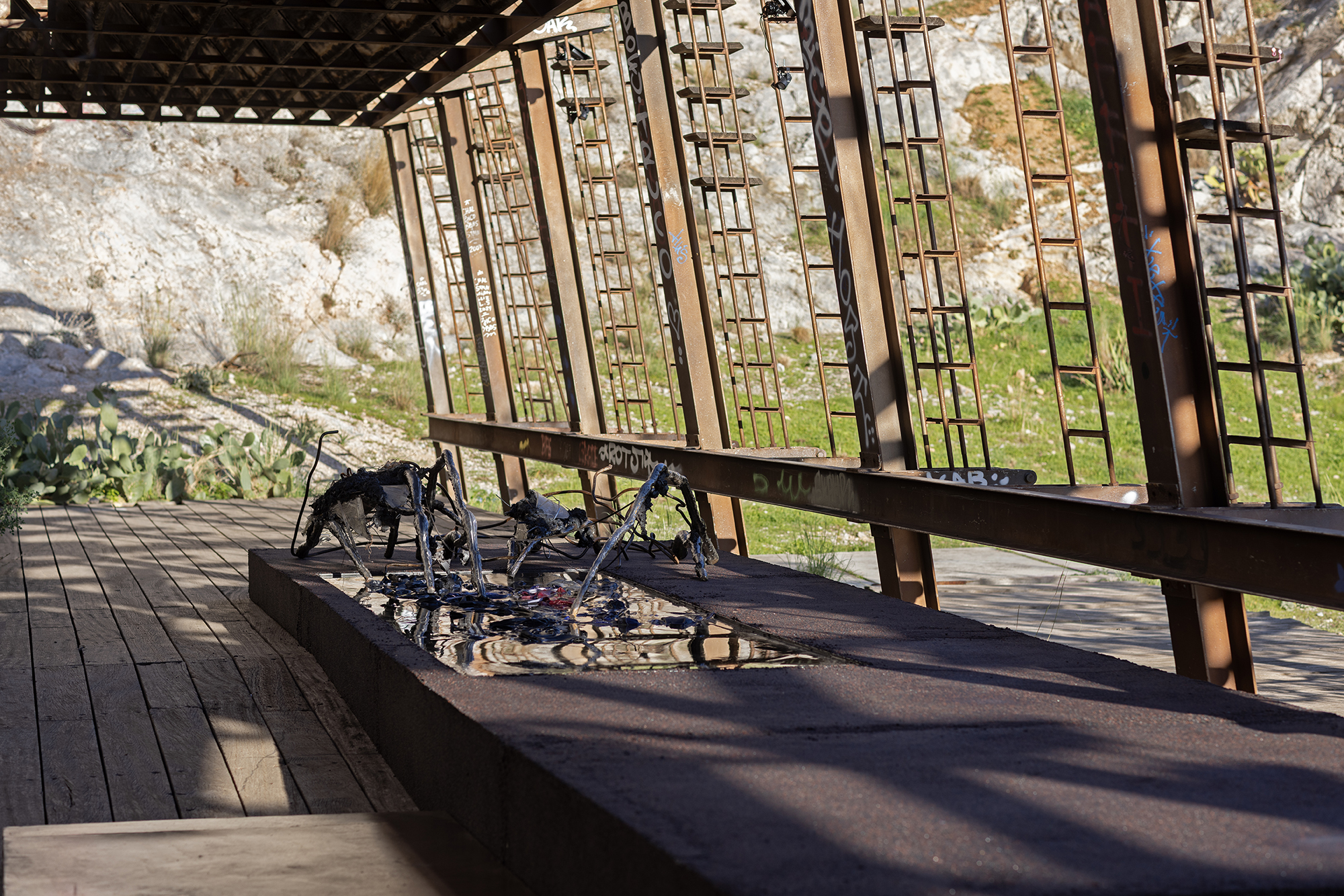
Alexandros Tzannis, Athens Dies In Dreams At Sunrise Installation, NEON City Project 2025
The other Greek term connected to gleaning, παλιατζής (paliatzís), was spoken by the members of Collectif MASI. Its members are the Greek architect and urban scenographer Madlen Anipsitaki and the French sociologist Simon Riedler. Their work focuses on the development of participatory, relational, and social projects that allow for a rethinking of contexts, a re-articulation of social sectors, and the creation of new bonds. They refer to this type of practice as “social sculpture” and it is generally traversed by the production of pieces, objects, or structures based on the use of materials gathered from the street.
Their urban wanderings are never detached from gleaning materials they chance upon. Attending to the tacit and anonymous exchange this implies, they came to call these findings “gifts from the street”. The materials accumulate and are ordered in the studio, awaiting use in each project. Like a great marble quarry, the city provides them with materials that subsequently shape the direction of each project’s realisation. This also occurs because the materials exchange their meaning and utility and are often placed in a symbolic position in relation to their new use. With very striking and contrasting colours, the projects they produce in the studio oscillate between a maquette and the creation of new uses for domestic objects.
These gifts from the street are offered only to those who walk with an attention that is, most of the time, directed towards the ground. In that kind of moving gaze, we stumble upon the marble steps that emerge from the ground of Athens. Not only in the historical remains of the Acropolis, but also in modern buildings that rise just a few centimetres before reaching the front doors. These primary forms, like monoliths of the city, determine a way of walking and, therefore, an inclination of the gaze, an oblique attention. From this image it becomes possible to identify, in the works of many artists, an awareness of the surface on which they walk: an incorporation of the signs of the street that has deepened and complicated my current research.
Throughout these explorations, certain shared traits became visible in a transversal manner. Not as a common denominator that erases differences, but as a series of tensions appearing in different proportions within each practice: materiality as a form of thought, an oblique gaze directed towards the ground, and a constructive vocation arising from what is gathered. These three “marble steps” —if the figure is permitted— also guided the encounter with other artists. In the works of Giorgos Gerontidis, Dimitris Ameladiotis, and Athina Koumparouli, there is a particular quality in the modes of collection, gathering, restoration, preservation, and creation.
The attention to time and things fluctuates in different ways across projects such as The Department of Artificial Butterflies (DoAB) and Sea Glass Factory, by Giorgos Gerontidis, which tension the relationship between artificiality and treasure within the logic of collections, modes of finding, and conservation techniques: the former through the allegory of the museum, the latter through that of the factory. In 2023, Dimitris Ameladiotis participated in one of the actions of Sea Glass Factory, undertaking a guided performative walk. He is an artist whose practice centres on the collection and accumulation of a great diversity of objects, materials, and fragments, which he subsequently rearticulates into different types of objects and installations. Although performative action runs through much of his work, in his objects he develops a thinking about things grounded in the way materials are found. For Ameladiotis, it is the psychological and biological sensation that materials produce that defines his work —a kind of obstinacy that particularly interested me.
Although I was unable to visit the studios of any of these last artists, conversation and the review of images sufficed for a first approach to their work. The material intrigue left by observing their works through images I was able to partly satisfy through some of Dimitris Ameladiotis’s notebooks, in which he leaves marks of writing and drawing on books and notepads: an incisive, corporeal kind of mark, as if made with a burin, that transforms the material condition of the paper.
If in the artists mentioned above the practice is strongly traversed by collection, in the work of Athina Koumparouli her role as an art restorer also intervenes. This grants her a very particular gaze upon materials, which leads to procedures and methodologies close to archaeology, where looking downwards and excavating what lies beneath the surface has structured many of her projects.
When I visited her studio, she was preparing her latest project, Deep Sea, Deep Time, in which she addresses questions related to technological obsolescence and its remains as future vestiges that will bear witness to certain unbridled and violent uses of natural resources and their consequent effect on societies. The most striking aspect of her process was the use of the outer film of discarded screens, arranged as skins over a structure. A material that, with its dark and reflective quality, acquires glimmers when illuminated. It is a work in which looking downwards and excavating forms part of a practice situated between media archaeology and critiques of extractivism.
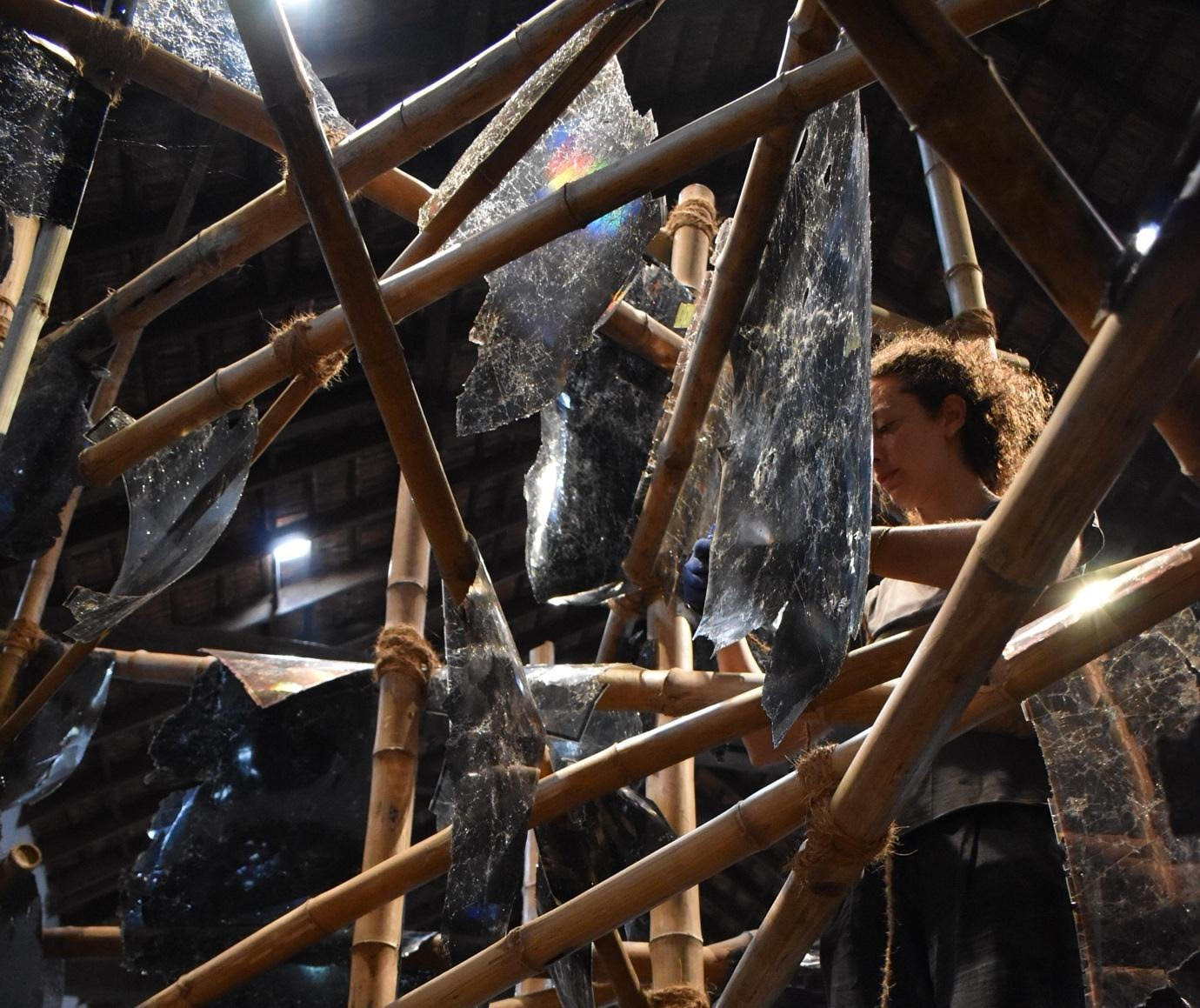
Athina Koumparouli, Deep Sea, Deep Time, Kochi, India, 2025
The images and objects that The Phantom Investigations gathered in the Berlin markets were domesticated images of Greece —stereotyped, hegemonic, touristic. What I found was their reverse: a city that works with its own remains without aestheticising them, that gathers them from the ground and reintegrates them without erasing the marks of time. Athens ultimately configured itself in my experience as a place with a singular combination of city and sea, architecture and nature, elevated views and narrow pathways: a tension that presents itself in a permanent movement between each threshold.
Returning to these ideas, I come back to the initial image and the provisional definition of Athens as the city of marble steps. This figure condenses a logic I found in the artists I visited: the material does not cover, it constitutes. Something essential lies in that difference. The steps are not a cladding over something else; they are the very body of the form. In the same way, the gestures of collection, conservation, and assembly that run through these practices do not represent an idea of time but build it from within. Throughout this journey, a relationship has emerged between the body’s posture, the regime of the gaze, and materiality. From there, the act of gleaning becomes an impulse to cross the threshold and fragment the linear temporality imposed upon beings and materials.
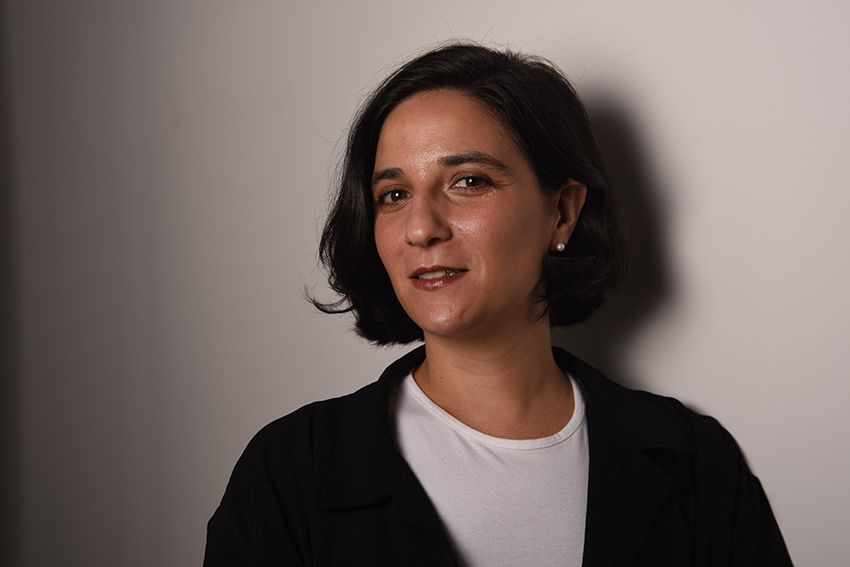
Clarisa Appendino was in residence during October 2025 as part of ARTWORKS Connects program, which aims to strengthen the international outreach of the Greek art scene through curatorial residency and exchange initiatives.
The curatorial exchange program between ARTWORKS, BIENALSUR & FRAC Corsica is co-funded by BIENALSUR, FRAC Corsica, and ARTWORKS. ARTWORKS implements the program with the support of the Stavros Niarchos Foundation (SNF).