EMBRACING SLIPPAGE: BETWEEN OLFACTION AND LANGUAGE • ELEKTRA STAMPOULOU IN CONVERSATION WITH CATERINA STAMOU
1. Going back to the first time I visited your studio a few years ago, I remember you telling me that for you “everything is text”—a phrase that clearly echoed Derridean influences in your artistic practice. How does this preoccupation translate into your work centered on the olfactory? And how did you first become interested in scent as a narrative medium?
In many ways, one could argue that scent and language are too disparate to belong to the same discussion. Partly because trying to “frame” a scent in words is rather pointless. It might even be impossible to describe; harder, perhaps, to confine in language than in space. At the same time, both scent and language share an ambiguous, playful quality, and this is precisely where narrative emerges: as an attempt to bridge the two, with description constantly sliding toward external referents or personal experience. It is an attempt destined to fail, since scent rests on presence and embodied experience, but I find it very interesting to work with a medium that repeatedly escapes, confuses, even disappoints.
Apart from chemical terminology, scent also lacks a concrete and specific vocabulary. We usually resort to phrases like “it smells like…” or “this reminds me of…”. That slippage, that inability to stabilize meaning, is something that deeply interests me. I think this is also why I became increasingly interested in olfaction as a narrative medium. It allows for forms of meaning-making that exceed language or at least destabilize it. Scent is diffusive, relational, and impossible to contain; it creates space of its own and situations rather than fixed representations. In that sense, I approach it as a way of producing embodied, participatory narratives that unfold through presence and experience.
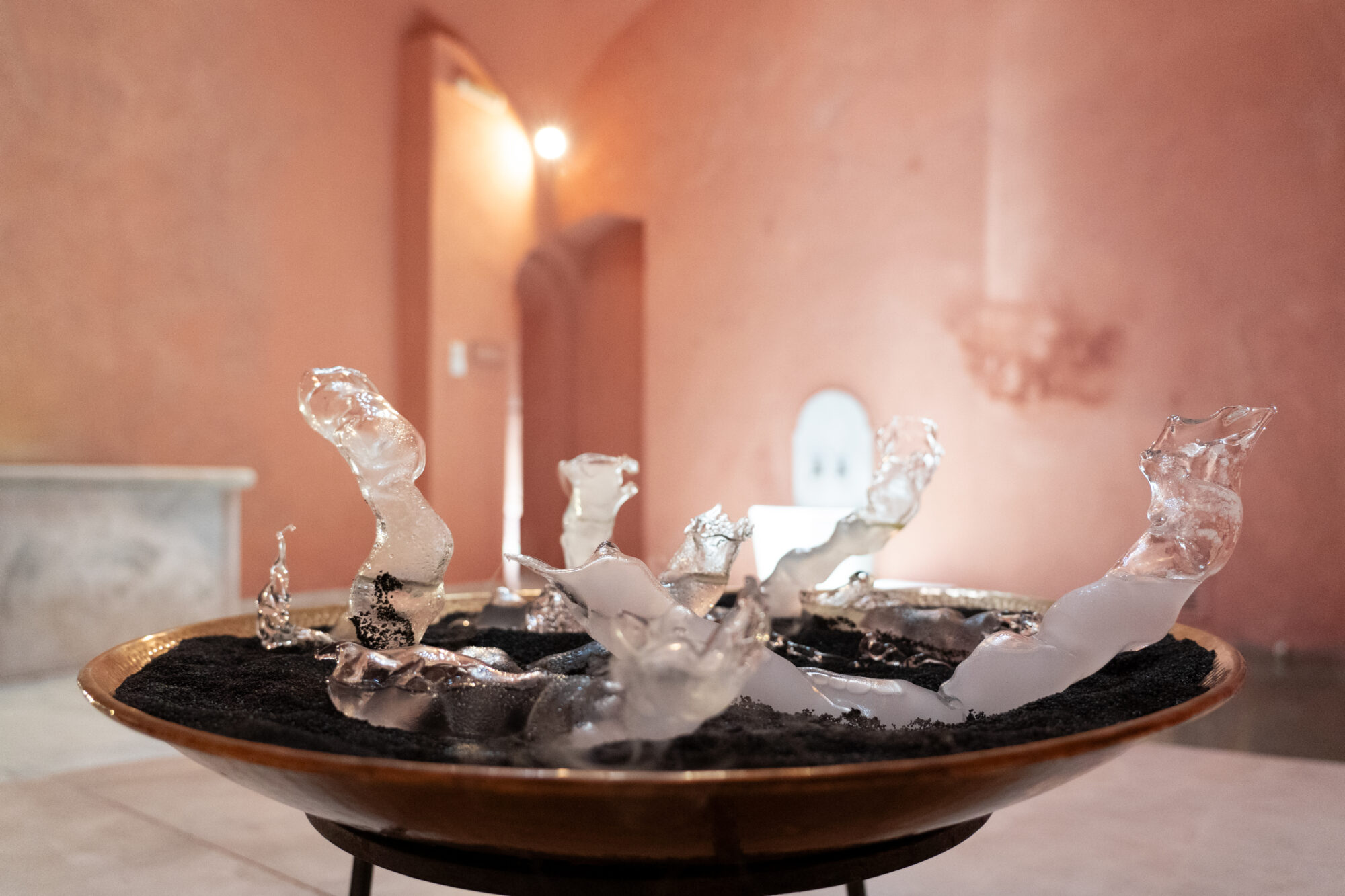
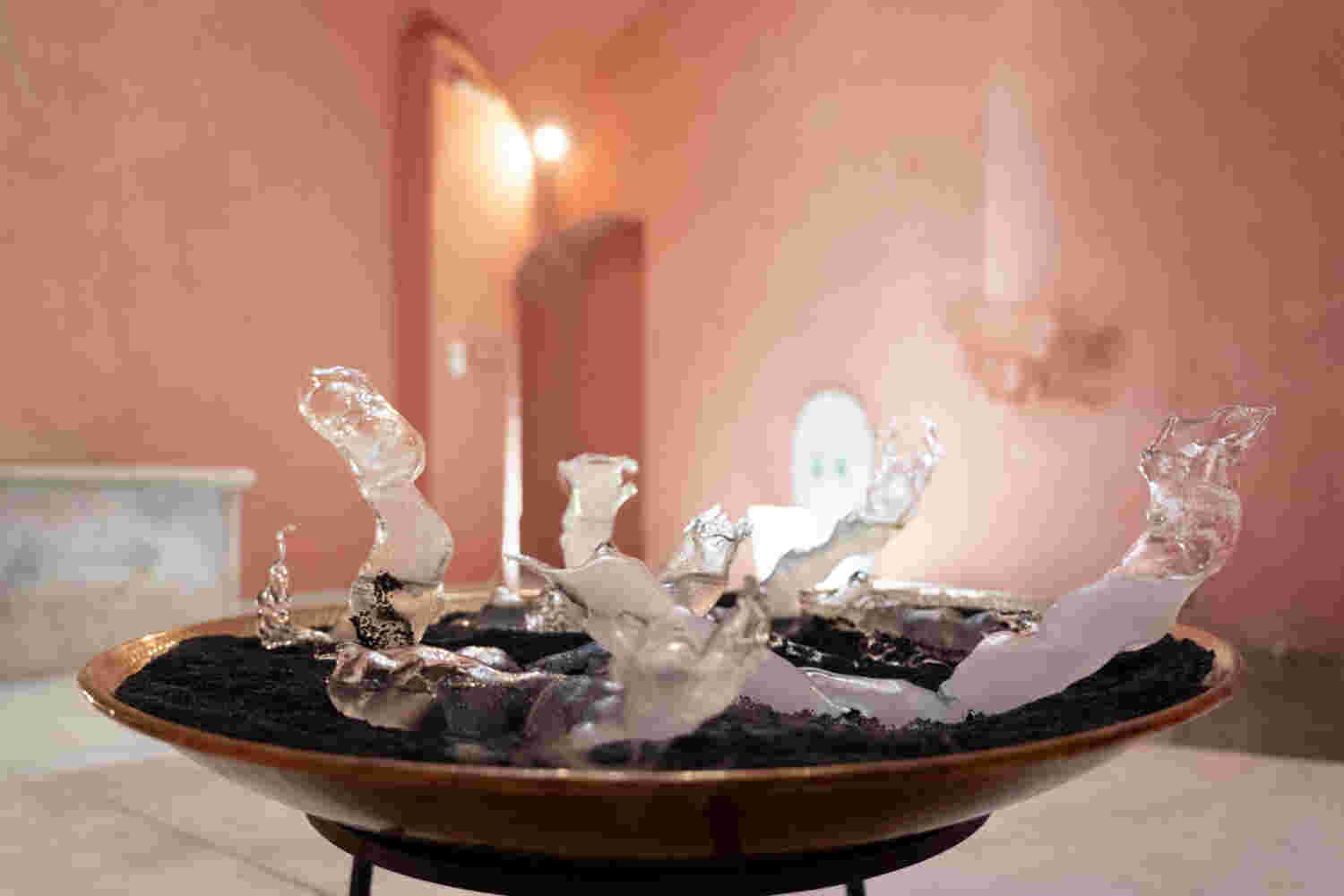
Elektra Stampoulou, Thirsty Towels, 2025, Photo: bmin0r
2. You have a background in English language and literature, ethics, and visual arts. As a research-based artist, you move across literary and critical theory, philosophy, fairy tales; yet at the same time, you work through distillation and scent formulas, taking on the role of an alchemist. How do these seemingly different paths come together and inform one another in your practice?
Reading, making things, and movement are what I have gravitated towards, and they are the practices I continue to return to and actively keep space and capacity for. So, I would situate my practice at the intersection of curiosity, experimentation, trial, and error, and an embrace of constant failure. Theory and material experimentation are not separate processes. My research often begins with reading, but eventually becomes material, or spatial in some way. Distillation, formula development, writing, and storytelling are simply different paths for approaching similar questions, or better yet, tools that allow different nuances. I see these fields just as different modes of inquiry. I am especially interested in forms of research that move beyond strictly textual knowledge production and toward multisensory or experiential methodologies.
3. Your work is inherently participatory, inviting the audience to engage with it sensorially or to take part in your research process. What interests you most about participation? How does participation influence your experience as an artwork’s creator?
I view participation mainly as a way to renegotiate the artistic result and let go of strict artistic authorship. Inviting more people into the process, opening up the making of the work and the supposedly “final” result, accepting collaboration, or embracing the absurdity of seemingly external input can be chaotic and difficult, yet invaluable. Participation also introduces unpredictability, which I deeply value. Especially with olfactory work, reception is never stable or universal. People bring their own memories, associations, and aversions into the encounter, and that fundamentally reshapes the work each time. I am interested in creating conditions for shared agency and multiplicity, where meaning is collectively negotiated rather than fully authored or presupposed in advance.
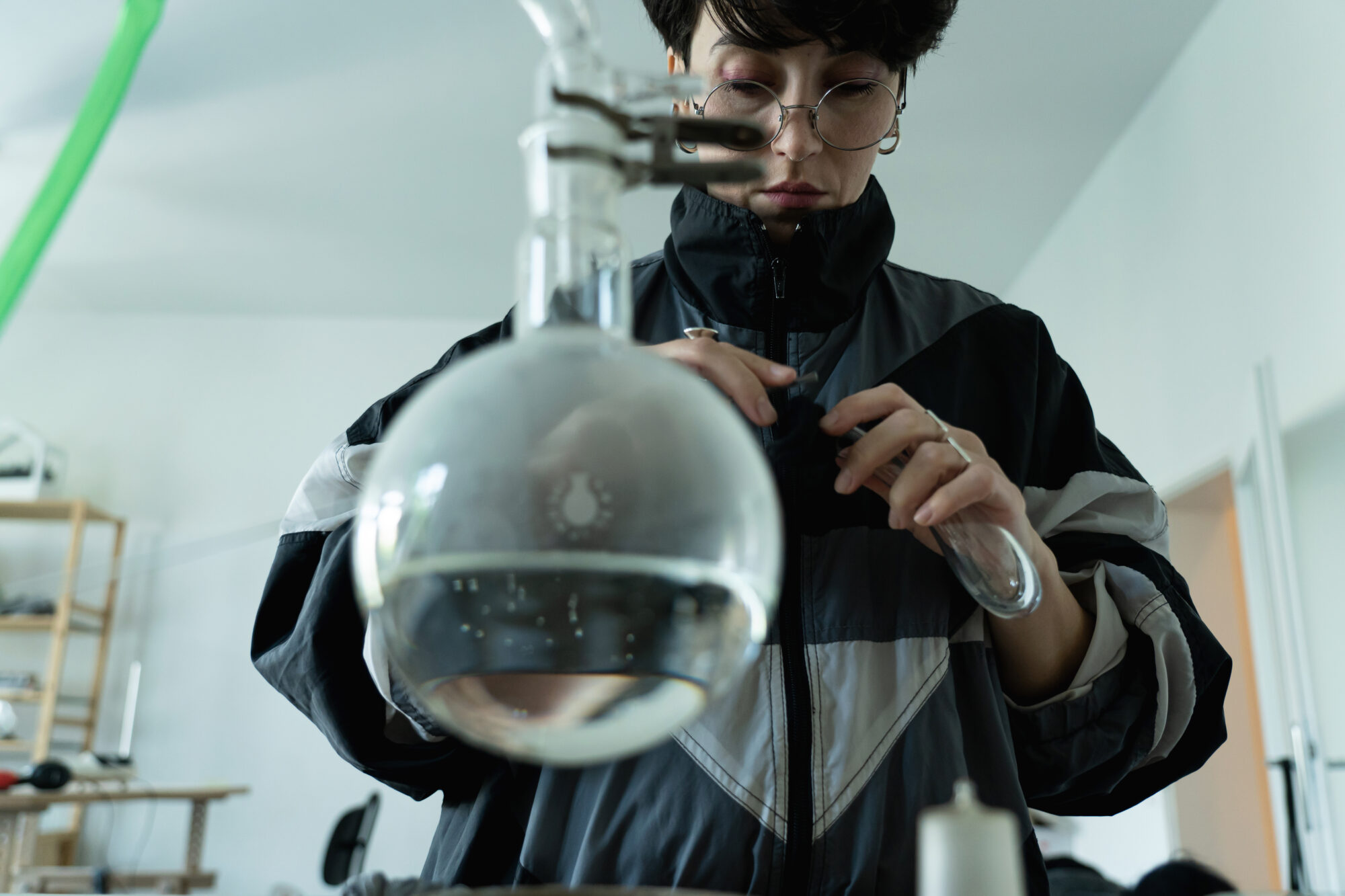
Elektra Stampoulou, Laboratory, Photo: bmin0r
4. How do you approach the relationship between the immaterial – the olfactory – and the physical components of your works and installations? Black recurs in your objects, alongside transparent elements, such as hand-blown glass, and metallic shades. How do choose your materials?
Beyond the strictly practical aspects, which depend on various factors [for example, glass can bear scent without affecting its chemical composition or absorbing it] I would say that I try to use the material that best fosters the concept. Chromatically, I have always gravitated toward darker tones and transparent materials. I experience a slight form of optico-olfactory synesthesia, so colors can trigger scents for me. Because of this, I tend to keep the work chromatically “quiet,” while allowing more room for formal or spatial exploration through shape and texture.
5. Many of your projects’ titles, especially earlier ones, are made up of letters or punctuation marks, such as [___], | = | and O, suggesting a strong preoccupation with the limits of language. What draws you to language and its discontents?
Mainly the fact that language is a material that is always present and infinitely malleable. Its limitations and impasses, its symbols and markings, are there to be addressed and stressed in order to actively push toward resignification. The possibility and ability to re-iterate in terms of language, be it text, material, scent, this “displacement” is what enables some kind of development. Meaning is never fixed; it constantly shifts depending on context, repetition, reception and much more. I think that kind of instability is rather generative.
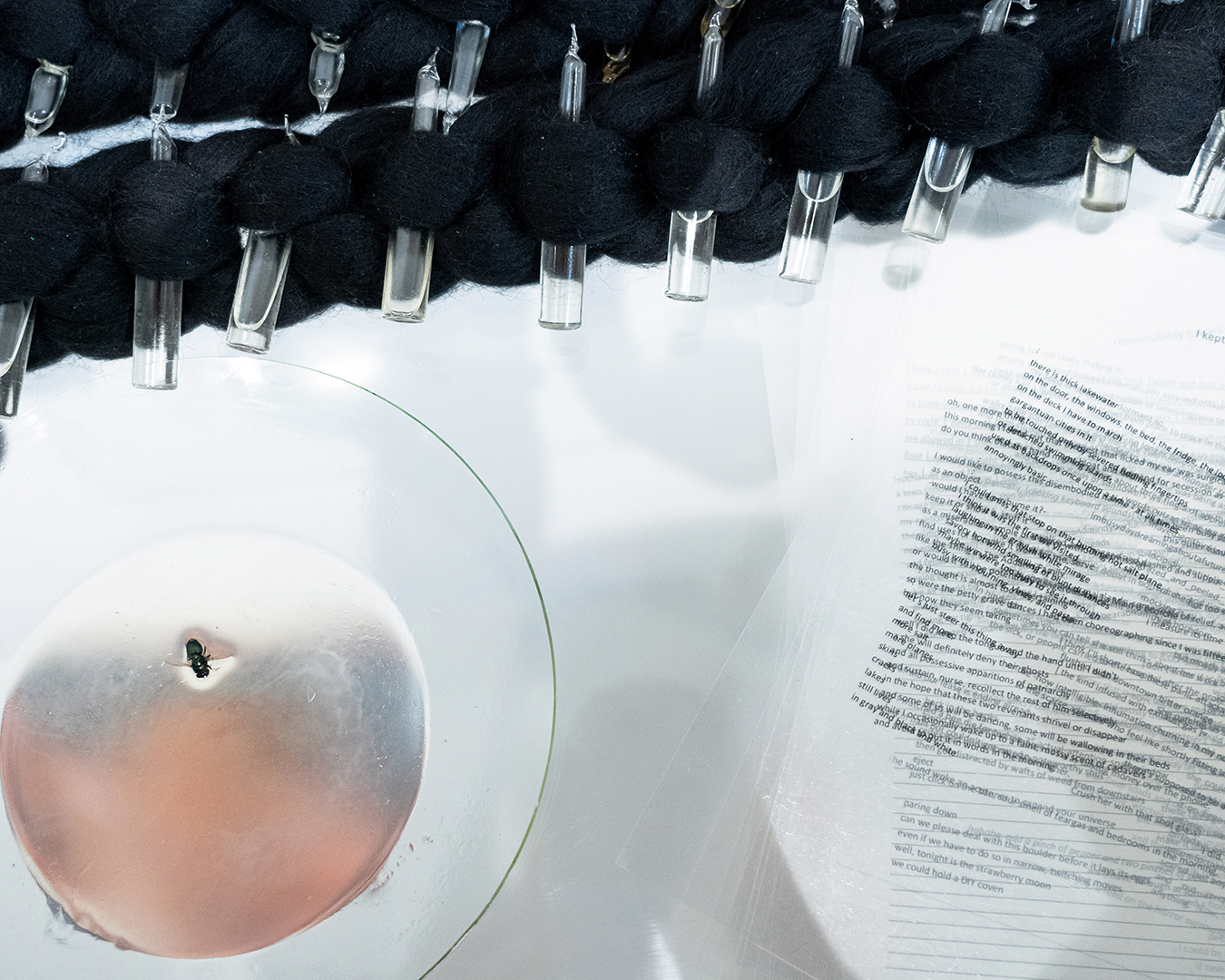
Elektra Stampoulou, Rehearsing dormancy so far, 2023, Photo: bmin0r
6. Your project “rehearsing dormancy”, so far, developed during an art residency at the Fresh A.I.R. residency program in Germany in 2022, clearly articulates the way your practice navigates the tensions and intersections between the personal and the political. How would you say the political is reflected in or influences your work?
Power dynamics, societal structures, and ideological choices affect all aspects of life, so I do not think artistic practice can ever truly exist outside the political. In my work, I am particularly interested in how politics permeates sensory and everyday experience. With olfaction especially, I became interested in the ways in which it is related to dominant discourses, and whether one could attribute scents to political systems, ideologies, or forms of governance, and what such associations might reveal about dominant narratives, fear, comfort, disgust, desire, or belonging. Rather than approaching politics through direct commentaries or representation, through familiar systems that use specific language or imagery and evoke particular sets of ideologies, I try to explore it through the ways political realities are already felt and lived sensorially.
7. Olfactory art, although gaining visibility (an oxymoron in itself!), still remains relatively marginal within broader contemporary art audiences. What are the challenges, and conversely, the unexpected freedoms, of working with such a medium, particularly as an artist in Greece?
Working within a medium that still remains relatively niche comes with unexpected freedoms. Because there are fewer established conventions or expectations around olfactory art, there is more room for experimentation and hybridity. Audiences often encounter it with curiosity and uncertainty, which creates space for experimentation. The main challenge is often practical. The majority of the scent industry and raw material market exists outside the EU, so sourcing materials can be difficult. Also, scent is an inherently ephemeral medium; it disperses, contaminates, transforms, fades, and ultimately resists permanence. Working in Greece also means navigating a context where institutional support for such practices can be limited, but it also creates possibilities for building alternative networks and approaches outside more rigid frameworks. Beyond that, olfactory art also operates against certain sensory hierarchies. Sight and hearing are still generally privileged as “higher” senses, while olfaction is often associated with the visceral, the animalistic, memory, or affect. At least in Western contexts, odorlessness is frequently linked to cleanliness, order, and social acceptability, whereas strong smells are coded as disruptive, excessive, or, ultimately, appalling. I am interested in working within these tensions.
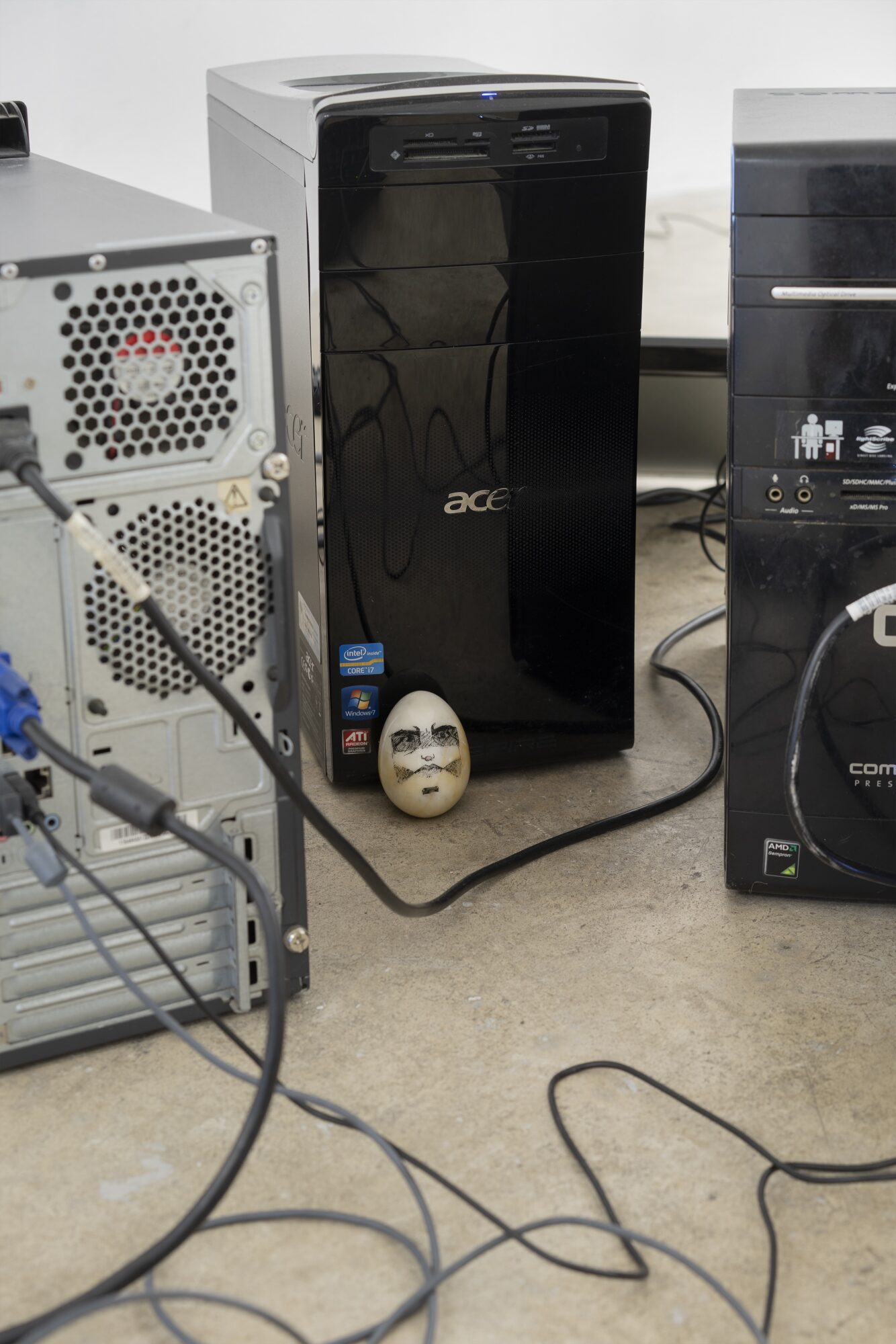
Elektra Stampoulou, Hard boiled hunt, 2023, Photo: Claude_barrault
8. I personally notice humorous elements in your work, such as the egg man in stalemate, or the sheep in the posters of Call it a Night. Is this something that aligns with your intentions, and how would you say it fits within your broader artistic practice?
Humor is a way to tactfully and tacitly approve of a less serious approach to one’s work, or undermine one’s position even while still holding it. In the fortunate event that it succeeds, it is a kind of shared moment with the person that experiences the piece, and a subtle, unspoken connection with them. As a viewer, I also deeply appreciate the works that manage to make me smile, precisely because many of the notions contemporary art grapples with can become overwhelmingly grave or can at times be perceived as pretentious. This is mainly why, I try to claim space for that lightness in my own work.
9. Would you say intuition plays a significant role in your research and practice, and if so, in what ways?
This is a challenging word for me because it draws along vaguely metaphysical connotations that I tend to avoid. To the extent that it refers to a kind of immediate, non-inferential cognition, I would probably say that instinct is the term I would trust more. Research and conceptual frameworks are very important in my practice, but at some point, there comes a moment where one has to make decisions that are difficult to fully rationalize or justify. I try to remain attentive to those impulses without mystifying them.
10. Alongside this, you play the theremin and have accompanied poetry readings and participated in sound performances (sometimes with me)! Is this something you see as complementary or in dialogue with your artistic work?
Our collaboration was actually the first time I performed sound live, and it was thrilling, to say the least. The theremin [which I only experiment with, since I would never claim to have a formal background in music] is in dialogue with my practice because of the way the instrument itself operates. It creates a field, this continuum that is very difficult to part and mark into distinct notes, and one’s hand slides into and out of this field in the air, without touching the instrument. It operates through proximity, and constant modulation. In many ways, it is perhaps the least haptic instrument. I think this relationship between presence, absence, proximity, and immateriality resonates strongly with the way I approach scent as well. Both scent and sound can create immersive spatial conditions that are difficult to fully delimit or stabilize. They unfold temporally, affectively, and relationally, often before they become fully interpretable.
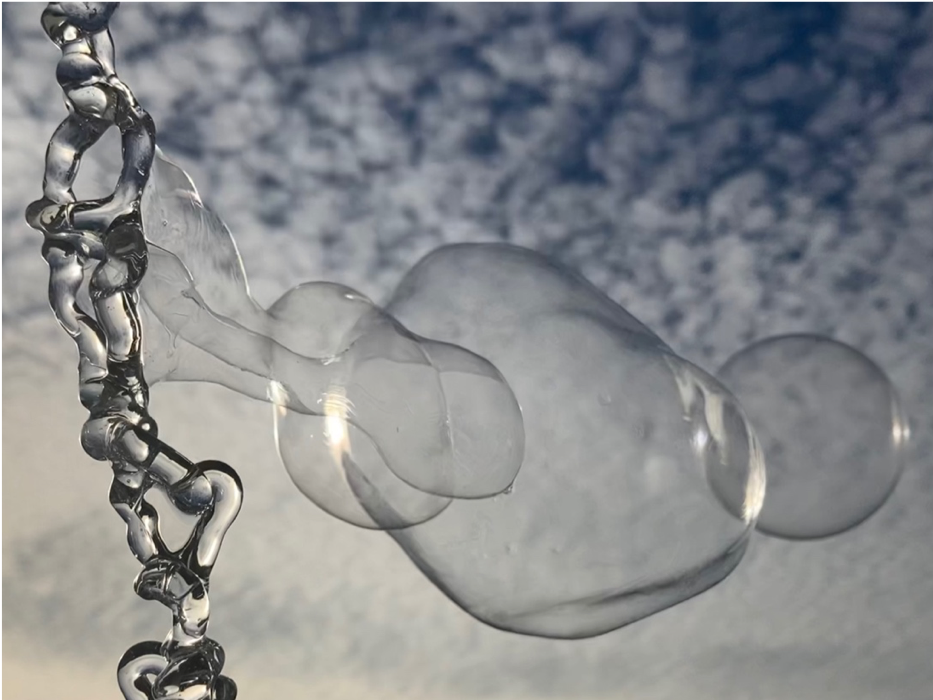
Elektra Stampoulou, She burst into a peal of laughter, 2024, Photo: Ηλέκτρα Σταμπούλου
11. You are currently preparing an exhibition at the Museum of the History of the Greek Costume. What will we see there?
This collaboration emerged rather serendipitously. The exhibition focuses on the scent of the dressed body and approaches garments not only as visual or historical artifacts, but also as carriers of bodily traces, and indicators of labor, care, desire, and social discipline. Through new olfactory and sculptural works created specifically for the exhibition, I attempt to activate speculative smellscapes around objects from the museum’s collection and reintroduce an olfactory relationship to items that are usually encountered only through vision, behind glass vitrines, or practices that have survived though textual descriptions.
A central aspect of the project is the relationship between scent and social regulation, i.e. how bodily odor becomes tied to ideas of class, gender, hygiene, desire, acceptability, or exclusion. The works do not function as olfactory representations but as tools for creating discontinuities within the museum narrative. Some works complement the exhibits by triggering imaginative narratives around the bodies that wore them, while others subvert the official narrative by introducing scents that create a counterpoint, treating smell as an equal medium of knowledge and historical access. More broadly, the exhibition continues my research into olfaction, materiality, and the politics of sensory experience, while also proposing a more multisensory and potentially more accessible way of approaching museum collections.
Elektra Stampoulou & Caterina Stamou are ARTWORKS Fellows.